[This story was submitted to and printed by the Washington Post for their “Summer Moments” feature in 2007.]
1964. World War II dominated the imaginations of us boys growing up in the ‘50s and ‘60s. Many of us had fathers and uncles who were not long back from the war theaters, or who hadn’t come back. An earlier generation perhaps played at cops and robbers or cowboys and Indians, but not us — for us, it was all the Germans and the Japanese. The Civil War enjoyed a vogue for a while during its Centennial, but it didn’t last.
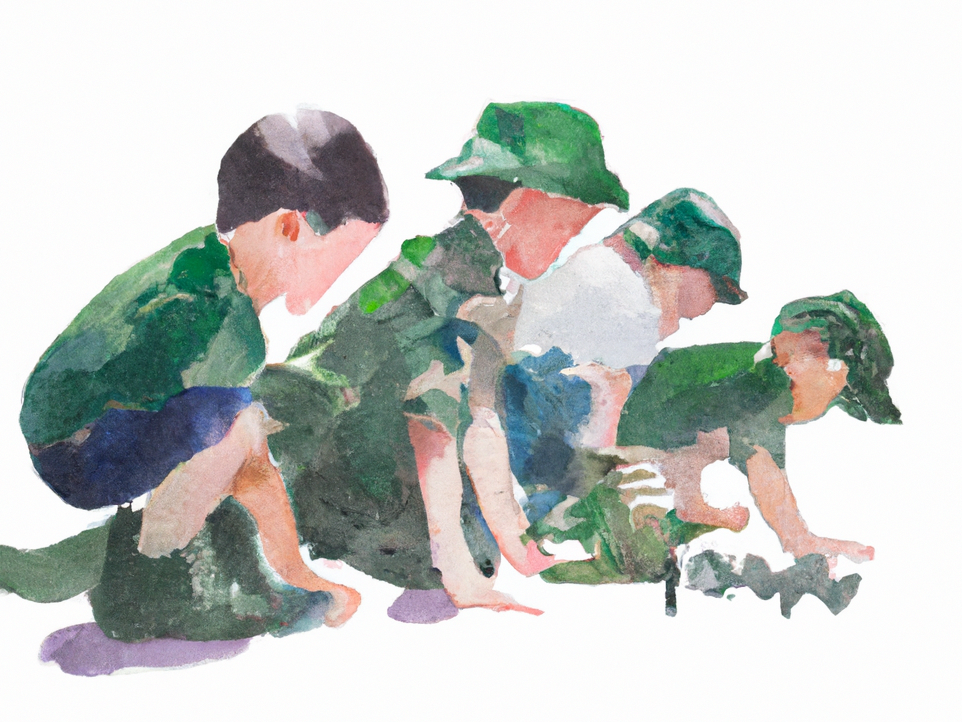
So all summer long, we played army, and it was army, not navy or air force, and our idea of playing Army was old-school West Point—it was to capture and hold territory, not to destroy other armies. That would peak for us around age 12, before we would begin to consider girls and cars, and by then we would have collected an impressive amount of materiel — rubber knives and bayonets, replicas of machine guns and BARs, ponchos, mess kits, walkie-talkies, pup tents, everything. There were no camp followers, of course, although from time to time some girls would suddenly appear, whip rocks at us, and flee.
Naturally we formed junior nation-states, so we could be the army of something. No sooner had Calvary Lands and Cimarron Drive settled into an uneasy truce, after a protracted series of inconclusive battles with each other, than a new threat arose in the north — Redfern/Brighton Park. Its army commander was one Johnny Hughes, a year or so older than most of us, and reputed to have 50 “men” under him, including “Madman,” the Sergeant Major. We had never seen this splendid force, but we knew a couple of guys who lived over there, and we believed their reports. Calvary Lands and Cimarron Drive concluded a mutual-defense pact and prepared for the worst.
Soon enough we met on the field of battle, a two-acre block that contained only our mutual grade school, surrounded by endless expanses of green. This was neutral territory, the Shelbourne/Lattimore alliance not having yet taken the field, and maybe a dozen of us were dug in between two wings of the school building, waiting for Johnny. When he arrived, he inexplicably had only a squad with him, but they were outfitted to the nines — floppy camouflage hats or helmets with netting, a make-believe mortar, a Radio Flyer ammunition wagon painted green, a rudimentary metal-detector for landmines, comms gear and code-books, binocs, scout bikes, some anachronistic bugles, even regimental colors — they were magnificent.
After a few feints, diversions, demonstrations, and a lot of yelling back and forth, young Private Cielke, on our side, sat down on a jagged rock and inadvertently opened a long, shallow cut on the back of his thigh. There was a sudden effusion of blood, and now the game had become real to us — Lieutenant McMullen, for all his claimed skill in deadly martial arts, was close to passing out at the sight. We’d heard all the health-class lectures on infection and lockjaw, and we were certain that Private Cielke was doomed. We had no way to contact a parent other than to run the six blocks home, and, it being summer, there was no one in the school who could help us. So we put up a white flag of truce and invited Redfern/Brighton Park to a parley in the middle of the field.
Captain Hughes himself grandly strode out to be briefed on the situation, and went back to our lines with us. He took one look and knew immediately what to do. His summer moment came then — he whirled about, cupped his hands around his mouth, and screamed, “MEDIC! MEDIC! WE NEED EVAC!!” toward his minions hunkered down a hundred feet away. Immediately a corpsman sprang up and sprinted toward us — he had a red cross on his helmet and he carried a green medical bag. When he got to the injured man, who was now moaning with fright at the rising commotion, the corpsman whipped out some alcohol swabs, gauze, and tape, and soon Private Cielke was headed stateside for R&R, on a litter hastily improvised by Sergeant Major Madman (who turned out be named Jerry) and carried by the two biggest kids from Redfern/Brighton Park.
The epic battle never resumed. We knew we could never compete with that kind of military planning and execution, and the Calvary Lands/Cimarron Drive coalition retired from the field. Besides, it was dinnertime.


Leave a Reply